Home / Tours / Rome / Ancient Rome Revealed: From the Forum to the Colosseum

Ancient Rome Revealed: From the Forum to the Colosseum

Price From €32 per person
Duration 3 hours
Group Up to 100 people
Difficulty Easy
Reviews 4.6 (4,349) Supplier's Tripadvisor reviews
Book Now

Tour Overview

Discover the glory of ancient Rome on a captivating guided tour through the Roman Forum, Palatine Hill, and the Colosseum. From Michelangelo’s Piazza del Campidoglio to the ruins of imperial palaces and the legendary arena of the gladiators, walk through

Embark on an extraordinary journey through the heart of ancient Rome with this immersive and expertly guided tour.
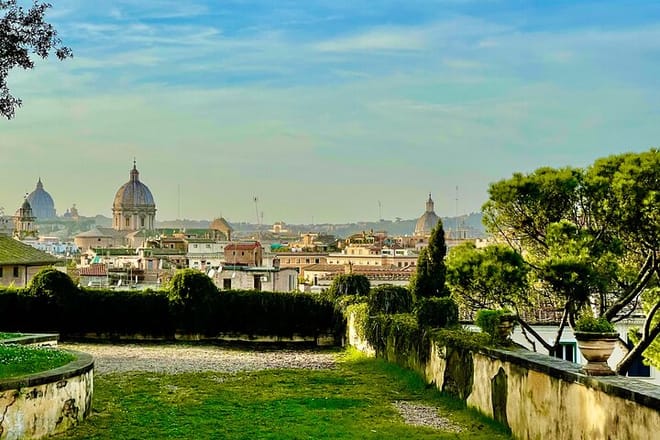
Your experience begins in Piazza del Campidoglio, a masterpiece of Renaissance urban planning designed by Michelangelo himself. From here, enjoy a panoramic view over the Roman Forum—one of the most iconic vistas in the city.

Step back in time as you explore the Basilica, the ancient markets, and the majestic Trajan’s Column, a marvel of imperial propaganda and engineering. Then follow a fascinating underground passage that leads to the Forum of Julius Caesar, where centuries of imperial ambition are revealed through layers of history. Emperors successively added temples, arches, and public spaces, making this area a true open-air archive of Roman civilization.

Continue your walk along the Via Sacra, the sacred road of Ancient Rome, in use for more than 2,500 years. Pass under the Arch of Titus, symbol of Roman military triumph, and climb the legendary Palatine Hill, where, according to tradition, Rome was founded in 753 BC. From this vantage point, enjoy sweeping views over the city and explore the sprawling ruins of the Imperial Palaces, once home to emperors and dynasties.

Your tour culminates with a close look at the Arch of Constantine and the most iconic monument of ancient Rome—the Colosseum. Learn about the architectural genius behind its construction, the dramatic spectacles that took place within its walls, and the stories of gladiators, wild beasts, and even mock naval battles that once captivated thousands.

This journey through ancient Rome is more than a tour—it's a vivid reawakening of history, bringing to life the legacy, power, and grandeur of the Roman Empire.

What's Included

  • Professional Licensed Local Guide (Blue Badge Certified) with in-depth expertise in Ancient Roman historyGuided small-group walking tour for a more intimate and engaging experienceHeadsets are provided to ensure you can hear your guide throughout the tour (for groups where applicable)Skip-the-line access and entry tickets included for:
  • Trajan’s Forum
  • Roman Forum
  • Palatine Hill
  • Imperial ForumVisit to Piazza del Campidoglio, designed by Michelangelo, with panoramic views over the ForumWalking route along the Via Sacra, passing the Arch of TitusCommentary on the Arch of Constantine and Colosseum, the gladiator arena, and ancient construction techniquesSupport from our on-site team, where needed

What's Not Included

  • Hotel pick-up and drop-off (meeting point details will be provided after booking)Food and drinks, unless specifically statedGratuities (not mandatory, but always appreciated)Colosseum entrance tickets (can be added as an optional extra upon request)
Your Itinerary

1

Piazza del Campidoglio

This square, from where you can enjoy panoramic views, was born according to the criteria of a uniform project due to the genius of Michelangelo; it stands on the Capitoline hill, where an ancient village was located, and the place was chosen to dedicate numerous temples to the Roman deities. In 1536, on the occasion of the visit to Rome of the Spanish emperor Charles V, Piazza del Campidoglio underwent a series of transformations due to the severe state of abandonment in which the hill found itself. Pope Paul III commissioned Michelangelo to complete the overall layout of the square. The Florentine architect created an elegant podium for the equestrian statue of Marcus Aurelius, placed in the center of the hill in 1537. Hence, this became the fulcrum of the new urban project. Furthermore, Buonarroti designed an imposing staircase with giant steps, the "Cordonata," which allowed knights to climb quickly, culminating with the solemn balustrade surmounted by classic marble groups.

2

Foro di Traiano

It was obtained by cutting the Quirinale and the Campidoglio slopes, connected by a mountain saddle. The excavation works were probably started under Domitian, in parallel with the arrangement of the Forum of Nerva. The undertaking, which had to be interrupted after the death of this emperor, murdered in a conspiracy in 96 AD, was continued by Trajan and financed with the booty obtained from the conquest of Dacia (now Romania), conducted in two subsequent military campaigns (101 -102 and 105-106 AD) and ended with the defeat and submission of the Dacians and the death of their king Decebalus. The architect of the work was Apollodorus of Damascus, a military engineer who had accompanied the emperor in the victorious war. The plan of Trajan's Forum was more articulated and complex than that of its predecessors: it included a vast square flanked by porticoes with exedras behind them, dominated on one side by the imposing Basilica Ulpia, behind which stood the Trajan's Column.

3

Colonna Traiana

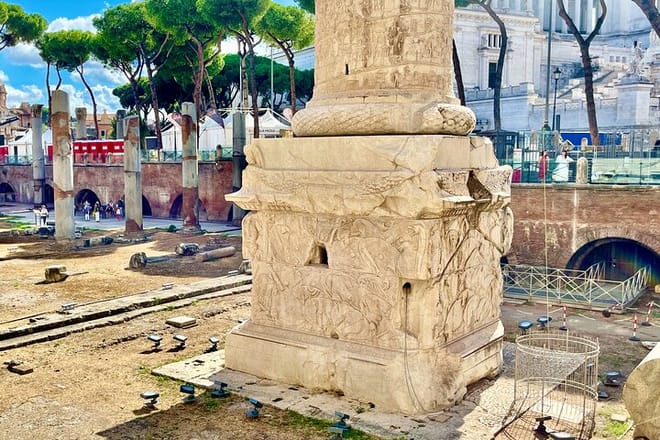
Trajan's Column narrates in images the two military campaigns of 101-102 and 105-106 AD. with which the emperor Trajan (98-117 AD) conquered Dacia, mainly corresponding to present-day Romania. Thanks to the extraordinary war booty, Trajan was able to build the most majestic of the Forums of Rome, which took its name from him and was inaugurated in 112 AD. The Column was erected in the center of a courtyard delimited by the monumental entrance to the Forum by the Basilica Ulpia and by the two libraries to the east and west. It rests on a base decorated with bas-reliefs depicting stacks of weapons. The shaft, 100 Roman feet high (30 meters), is composed of 17 colossal rocks of white Carrara marble, with a diameter of almost 4 meters. Inside is a spiral staircase of 185 steps leading to the top. The frieze is arranged around the shaft, imagined as a spirally wrapped scroll, approximately 200 meters long in total and densely animated with scenes with about 2,500 characters.

4

Roman Forum

Roman Forum, Latin Forum Romanum, the most important forum in ancient Rome, is situated on low ground between the Palatine and Capitoline hills. The Roman Forum was the scene of public meetings, law courts, and gladiatorial combats in republican times and was lined with shops and open-air markets. Under the empire, when it primarily became a centre for religious and secular spectacles and ceremonies, it was the site of many of the city’s most imposing temples and monuments. Among the structures surviving in whole or in part are the Temple of Castor and Pollux, the Temple of the Deified Caesar, the Mamertine Prison, the Curia (senate house), the Temple of Saturn, the Temple of Vesta, the Temple of Romulus, the Arch of Titus, the Arch of Septimius Severus, and the Cloaca Maxima.

5

Palatine Hill

The Palatine Hill, (/ˈpælətaɪn/; Latin: Collis Palatium or Mons Palatinus; Italian: Palatino [palaˈtiːno]) which is the centremost of the Seven Hills of Rome, is one of the most ancient parts of the city and has been called "the first nucleus of the Roman Empire." The site is now mainly a large open-air museum while the Palatine Museum houses many finds from the excavations here and from other ancient Italian sites. Imperial palaces were built here, starting with Augustus. Before imperial times the hill was mostly occupied by the houses of the rich. The hill originally had two summits separated by depression; the highest part was called Palatium and the other Germalus (or Cermalus). Using the Forma Urbis its perimeter enclosed 63 acres (25 ha); while the Regional Catalogues of the 4th century enclose 131 acres (53 ha).

6

Arch of Costantine

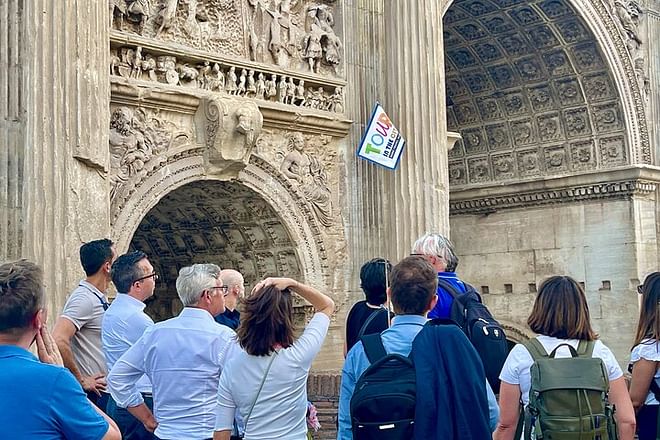
The Arch of Constantine is a triumphal arch in Rome dedicated to the emperor Constantine the Great. The arch was commissioned by the Roman Senate to commemorate Constantine's victory over Maxentius at the Battle of Milvian Bridge in AD 312. Situated between the Colosseum and the Palatine Hill, the arch spans the Via Triumphalis, the route taken by victorious military leaders when they entered the city in a triumphal procession. Dedicated in 315, it is the largest Roman triumphal arch, with overall dimensions of 21 m (69 ft) high, 25.9 m (85 ft) wide and 7.4 m (24 ft) deep. It has three bays, the central one being 11.5 m (38 ft) high and 6.5 m (21 ft) wide and the laterals 7.4 m (24 ft) by 3.4 m (11 ft) each. The arch is constructed of brick-faced concrete riveted in marble. Though dedicated to Constantine, much of the sculptural decoration consists of reliefs and statues removed from earlier triumphal monuments dedicated to Trajan (98–117), Hadrian (117–138) and Marcus Aurelius (161)

7

Colosseum

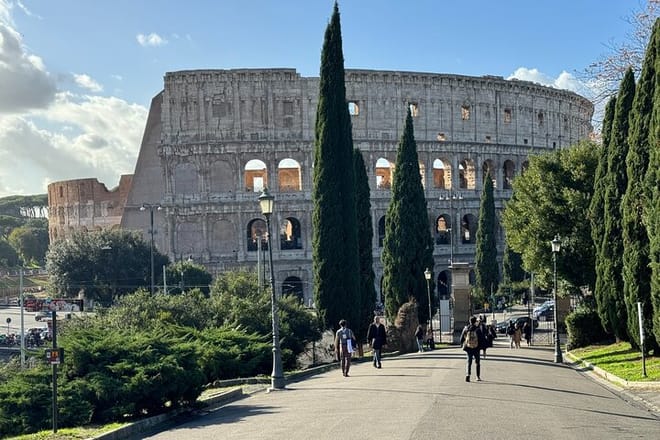
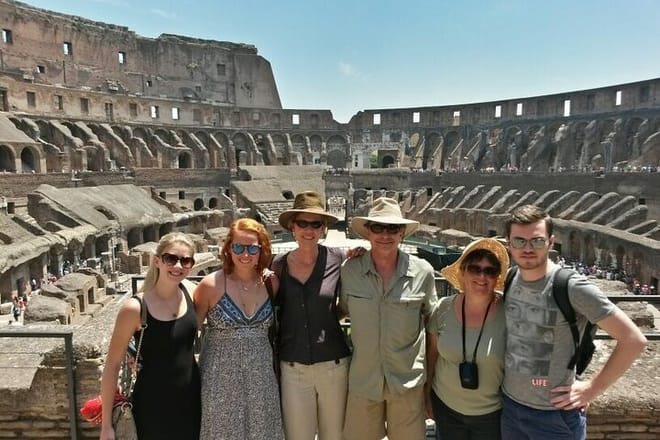
Your guide will show you the best-preserved part of the Colosseum, entertain you with tales of sea battles, and tell you about the Gladiator's combats and animal fights. Imagine the roar of the crowd as their bloodlust was met. Called by the ancient Romans "Anphitheatrum Flavlum" (Flavian Amphitheatre), the Colosseum is the most famous and impressive monument of ancient Rome and the largest amphitheater in the world. The name is undoubtedly linked to the large size of the building but derives above all from the fact that nearby, there was a colossal statue of Nero and bronze. In 1990, the Colosseum, along with all the historical centre of Rome, the Vatican extraterritorial zones in Italy and the Basilica of St. Paul Outside the Walls, was listed as a World Heritage Site by UNESCO, while in July 2007 was included among the New seven Wonders of the World.

Cancellation Policy

Free cancellation up to 72 hours before the experience starts.

Additional Info

  • Experience type Cultural & Historical
  • Logistics & comfort Skip-the-line / Reserved Access
  • Book in advance 3 days before
  • Difficulty Easy
  • Starts 08:30, 09:00, 10:00, 10:30, 11:00, 14:00, 15:00, 16:00, 17:00
  • Language English, French, Spanish, Italian, German
  • Group size Up to 100 people
  • Operated by Tour in The City

Tags

  • Cultural And Theme Tours
  • Walking Tour
  • City Tours
  • Skip The Line
  • Language Tour
  • Educational Tour
  • Eco Friendly
  • Group Friendly
  • Youth
  • Family Friendly
  • Couples
  • Private Activity